HOW COULD COLLABORATIVE LEARNING POTENTIALLY IMPACT PRIMARY EDUCATION? Beth Gibbs
Blog
3! During this blog I am going to explore collaborative learning and discuss
benefits and negatives of this approach.
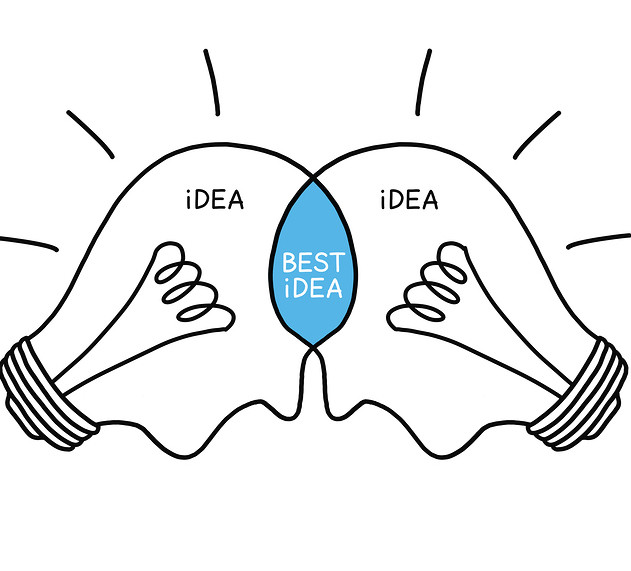 Collaborative learning has become popular in recent years as we have steered away from didactic teaching and embraced group projects. The National Institute for Science Education (NISE, 1991) suggests that collaborative learning is an approach to teaching and learning where that involves groups of individuals will work together to complete a task or share ideas. However, according to Richardson (1999), just because children work in groups, does not mean they work as a group. Collaborative learning is not restricted to just students but it has shown to be beneficial for teachers and students to collaborate as well.
A
possible barrier to collaborative learning may be when there are shy students
that do not feel confident expressing their ideas in front of a group. A way to
combat this is to possibly use technology, more specifically ‘Google Docs’ because
it allows students to communicate their thoughts and ideas within their groups without
feeling under pressure but still enabling collaborative learning.

Another
way that technology can enable us to collaborate in the classroom is through
Skype. Before Christmas, within lectures we have been Skyping a school in
Nairobi. They told us about what their school and culture was like. However, this
school does not have the resources or learning tools that we take for granted
in our own school settings so each of our seminar groups collaborated on ideas
to raise money for them. In the end there was a cake sale, a guess the name of
the bear game and a sponsored cycle within the lobby of Cardiff Met. In the end, nearly £300 was raised for the
school in Nairobi. This is a good example how collaboration could be used in
primary education. To provide larger collaboration opportunities you could
involve the parent/carers and even the wider community.
At
my placement settings at a local primary school I have observed collaboration
at this scale, the year 6 children were raising money for their Christmas/winter
fate. They collaborated with local businesses to donate food or furniture
anything that could be sold and to volunteer on the stalls. The children of year
6 organised the whole event, even deciding on the prices. Their teacher said
that every year after this type of project they have twice as much confidence,
which is important to prepare them for secondary school.
Donaldson
(2015), incorporated collaborative learning within his review of the Welsh
curriculum, as he believed it provided both short-term and long-term benefits
not just to students but also teacher’s pedagogy. He believed that through
collaborative learning approaches, teachers are able to tailor education to
individuals and therefore provide a more effective learning outcome. Students
are able to practice teamwork skills and build confidence through problem
solving and achievement.
According
to Cummins (2001), it is the teacher’s role to engage with all students so they
can develop confidence through collaboration with each other. This is to ‘empower’
students to gain autonomy over their own learning. Teachers can inspire and
create collaborative opportunities and encourage critical thinking for their
students through both adult-led and child centred play (Wingrave, 2014). We are
no longer putting emphasis on independent learning, the focus has shifted to
collaboration. Collaboration is at the heart of the working world so by giving
children the opportunities to practice now, teachers are preparing them for the
future. Through collaboration and large group work we develop our language and
social skills as we practice how we convey ideas to others and the key to
successful collaboration is communication. This will improve with practice. Another
benefit of collaboration is that teachers will have a better knowledge of what
their abilities are, making it possible to change their learning to suit their
individual needs.
According
to Johnson et al. (1994), co-operative learning is used in conjunction with
collaboration and arguably they both essentially mean the same thing, to work
in partnership and share ideas to solve problems.
Reference
List:
Cummins, J. (2001) ‘Empowering Minority Students: Framework for Intervention’,
Harvard Educational Review, 71(4), 649-75.
Donaldson, G.
(2015) Successful Futures: Independent Review of Curriculum and
Assessment Arrangements in Wales. London: Crown Copyright.
Johnson, D. W., Johnson, R. and Holubec, E. (1994) Cooperative Learning
in the Classroom. Association for Supervision and Curriculum Development
NISE (1991) What is Collaborative Learning. Available at: http://archive.wceruw.org/cl1/CL/moreinfo/MI2A.htm
(Accessed: 09.01.18)
Wingrave, M. (2014) Teaching and
Learning in Primary Education. London: SAGE


Comments
Post a Comment