What is the value of the Welsh language in primary education? Beth Gibbs
What
is the value of the Welsh language in primary education?
I
have very little experience observing whether not the Welsh language is valued
within schools, as I did not attend school in Wales. However, the school I
volunteer at does very little Welsh with key stage 2 pupils however it is
encouraged more in the nursery and reception class with multiple Welsh reading
materials and repeating Welsh words from the teachers. However this was surprising
to witness as the Welsh language has been compulsory in Wales following the
1998 Education Reform Act where all pupils aged 3-16 years had compulsory Welsh
language. From speaking to peers that
have been to Welsh schools, secondary school really promotes the language in
preparation for a GCSE. They said that the lessons were really enjoyable as everyone
had a foundation already so it was fairly easy to get the hang of it. Although,
a few weeks ago we had a Welsh language lesson which I thought I would be
terrible at as I have always struggled to pick up languages, but I retained a
lot more than I thought I would. Perhaps it was because I was taught in a
really engaging way and by the end of the session I had manged a short
conversation in Welsh.
The
lack of emphasis on Welsh speaking within my placement may also be because
there are so many different cultures and languages it is important to be
inclusive and oftentimes they learn to communicate in English not welsh.
Donaldson’s emphasis on the Welsh language and culture within the review of the
Welsh curriculum suggests that teachers may have to learn welsh as well so they
are better able to guide and support children’s welsh language development. A
way to prepare for this is for teachers and parents to work together to learn from
fluent Welsh speakers so they can better support the children.
Donaldson
(2015), suggests that there is research that indicates there are cognitive
benefits of learning languages from an early age, that it can affect the way
you think and are able to successfully pick up other languages, more easily in
the future. This is one of the reasons why there is an increased importance being
placed on learning the Welsh language from an early age within Donaldson’s
curriculum review. Some studies suggest there is a difference in intelligence
between bilinguals and monolinguals (Barac and Bialystok, 2011), however other
studies suggest there is no difference in cognitive intelligence and that it is
a myth with no actual evidence to support it (Kempe, 2014).
Jones
(2016), highlights the fact that pupils are not engaged with learning Welsh and
there is not enough time to teach it. Nor do enough teachers have a good grasp
of the language and have the confidence to teach it through other aspects of
learning. As Donaldson’s recommendations come in to effect, children should be
learning holistically so they will not have a set slots for separate subjects. This
will enable children to practice their Welsh in other areas of their learning
and hopefully everyday rather than once every two weeks as it transitions into
a core area of learning and given the same importance as literacy and numeracy.
When Donaldson asked
school leaders on what they though was the three best things about education in
Wales, one of which was the Welsh language and culture and the Welsh Government
is dedicated to Wales prospers and keeps its language alive through the Welsh
Language Strategy (Welsh Government, 2012). It is important to promote Welsh culture and language
in school, to be prideful of your roots and whilst being able to communicate in
two different languages, without it, the language will eventually fade to even
fewer people speaking it and the Welsh culture will be lesser for it (Welsh
Government, 2013).
The Welsh
Language Strategy encourages a wider range of people to speak and learn Welsh
to increase the number of people that speak it. However this is difficult if
the fate of the Welsh language lies in the hands of disengaged children.
Educators need to make these lessons fun and get families involved so children
can practice language skills at home, at work, with their friends and within
school. The strategy aims to build a stronger foundation to support welsh
language as it becomes core subject within school. The tools that children use
to help learn two languages may come in handy if they can be applied to
learning other languages such as French or German, to be able to look for
patterns in different language structures.
Donaldson
(2015) makes it very clear that learning the welsh language cannot be
segregated into a separate subject that it needs to be incorporated in other
learning opportunities, an example of this could be practicing their welsh spelling
and speech during a maths lessons or exploring the outdoors and talking in
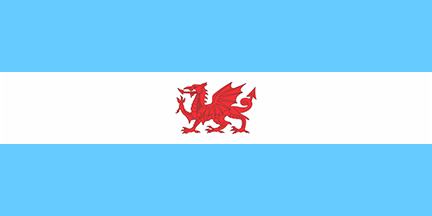
welsh instead of English for jump or run. Whilst conduction my research into
the value of the Welsh language I discovered that there is also a province
within Argentina that speaks only Welsh. This could be used as a tool to
promote an interest in the Welsh language as they could try to get in touch
with the people that live there and converse in Welsh. Below is the provinces
flag.
Reference List:
- · Barac, R. and Bialystok, E. (2011). ‘Cognitive Development of Bilingual Children’, Research Timeline. 44.1, 36-54
- · Donaldson, G. (2015) Successful Futures: Independent Review of Curriculum and Assessment arrangements in Wales. Welsh Government.
- · Education Reform Act 1988, c. 40. Available at: http://www.legislation.gov.uk/ukpga/1988/40/pdfs/ukpga_19880040_en.pdf Accessed: 15.04.18
- · Kempe, V. (2014). Being Bilingual does not make you smarter. Abertay University. Available online: https://www.abertay.ac.uk/news/2014/being-bilingual-does-not-make-you-smarter Accessed: 16.04.18
- · Jones, M. (2016). Research Briefing: Welsh-medium Education and Welsh as a Subject. National Assembly for Wales. Available online: http://www.assembly.wales/research%20documents/rs16-048/16-048-english-web.pdf Accessed: 16.04.18
- · Welsh Government (2012) A living language: a language for living – Welsh Language Strategy 2012–17 Welsh Government
- · Welsh Government (2013) One language for all: Review of Welsh second language at Key Stages 3 and 4 – Report and recommendations Welsh Government


Comments
Post a Comment